What is Qwen-Image, in short
Qwen-Image is the image generation line of Qwen, the model family of Alibaba’s cloud division. It arrived in August 2025 as a 20-billion-parameter model under the Apache 2.0 licence, with a technical report. It stood out for its text. Paragraphs, signs and labels came out legible, in English and above all in Chinese, where Stable Diffusion 1.5 and SDXL produced squiggles and the models of 2024 managed a few English words at best.
The current open release is Qwen-Image 2.1, published on 20 September 2026. It is a smaller and faster model: 7 billion parameters for the image generator, plus an 8-billion-parameter vision-language encoder. One checkpoint does two jobs. It generates an image from text, and it edits an existing picture from a sentence and up to ten reference images. It outputs native 2K and real transparent images. Its licence is no longer Apache: research and evaluation only.
Like Stable Diffusion and FLUX, it is a diffusion model that runs in ComfyUI on a consumer graphics card, and it reads the same kind of prompt. Where it differs is inside, and that is what the section on how it works explains.
What Qwen-Image 2.1 can do
Text-to-image at native 2K. The model renders 2048 × 2048 squares, 2528 × 1696 in 3:2 and 2752 × 1536 in 16:9 directly, with no upscaler. It reads the prompt as a text, so sentences, prepositions and layout instructions work, and quoted words appear as written: “a banner above the door reads ‘OPEN ALL NIGHT’” comes out as written on the test prompts of the settings guide. The settings guide gives the prompt structure that works best and the measured settings.
Editing with the same checkpoint. Give it a picture and a sentence and it changes the picture: replace an object, restyle a scene, add text. Give it up to ten reference images and it composes them, keeping a character or a product consistent across shots. Regions can be pointed at with a mask or a drawn circle. No separate inpainting checkpoint is needed for local edits: the same model takes the region as a hint.
Transparent output. Ask for an RGBA image with a transparent background and the model produces a real alpha channel, not a cut-out: the VAE encodes and decodes four pixel channels instead of three. Logos, stickers and layered assets come out ready to place.
Prompt rewriting. Qwen ships two companion models, Qwen3.5-VL 9B fine-tunes, that expand a short prompt into the detailed form the generator prefers, one for generation and one for editing. ComfyUI exposes them as an option in its templates, off by default; they are not required.
Speed. On a 16 GB consumer card the int8 weights take about 40 seconds for a 1-megapixel image and four to five minutes for 4 megapixels at the quality settings of the settings guide. A distilled Turbo checkpoint, released on 9 October 2026, renders in 8 steps, about seven times faster at 4 megapixels, at the cost of the medium: drawings, embroidery and paper-cut drift towards photographs.
Qwen-Image vs Stable Diffusion: how it works
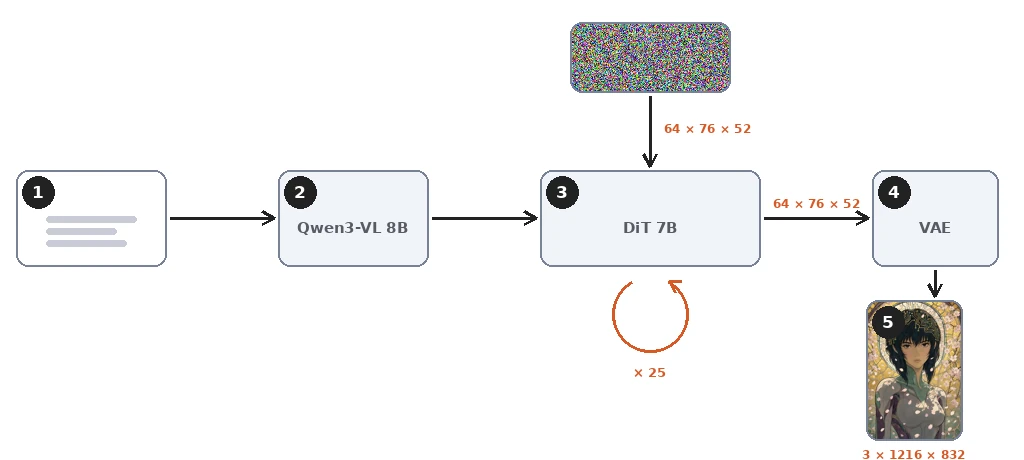
Qwen-Image 2.1 is a diffusion model, so the mechanics explained in the Stable Diffusion guide apply. A text encoder reads the prompt. A denoiser works on a compressed latent over a number of steps. A decoder turns the latent into pixels. What differs is the choice made for each of the three parts. The model’s repository gives the facts below; Qwen has not published a technical report for 2.1.
A vision-language model instead of CLIP
Stable Diffusion 1.5 and SDXL read the prompt with CLIP, a network trained to match short captions to images. Qwen-Image 2.1 reads it with Qwen3-VL 8B, a full vision-language model with eight billion parameters, more than the image generator itself. The same encoder reads the reference images in editing. That is why the prompt structure of the settings guide works. Sentences, prepositions, quoted text and layout instructions are what a language model is built to parse. A CLIP encoder tends to flatten them into a bag of concepts.
A single-stream transformer instead of a U-Net
The denoiser is a diffusion transformer of 32 layers and 7 billion parameters. SDXL uses a U-Net, convolution blocks with attention layers between them. Stable Diffusion 3 moved to a transformer too, the MMDiT, in which text and image tokens travel in two streams with separate weights and meet only in the attention of each layer. Qwen-Image 2.1 goes one step further: text and image tokens form one sequence and go through the same weights, which is what “single-stream” means. The first Qwen-Image of 2025 was a double-stream MMDiT of 20 billion parameters; 2.1 is about a third of that size.
Two details of its attention matter in practice. Text tokens are read causally, as in a language model, and each image, reference or generated, is one block whose tokens all see each other. The order is prompt first, reference images next, generated image last, and a token never looks at what comes after it. So the prompt and the reference images never see the image being generated, and the part of the computation that belongs to them, the prefix, is identical at every step: it is computed once and cached across the denoising steps. The QwenImage21Cache node of ComfyUI only chooses where that cache lives, in what precision, or whether it is used at all.
A 64-channel latent, compressed sixteen times
The VAE of Stable Diffusion shrinks an image by a factor of eight on each side into 4 channels, 16 in version 3. The VAE of Qwen-Image 2.1 shrinks it by sixteen on each side, into 64 channels. It also encodes and decodes four pixel channels, red, green, blue and alpha, instead of three, which is how the model outputs real RGBA images from the same 64-channel latent. For an 832 × 1216 image the latent measures 64 channels of 52 × 76: about 253,000 numbers for 3 million pixel values, twelve times fewer.
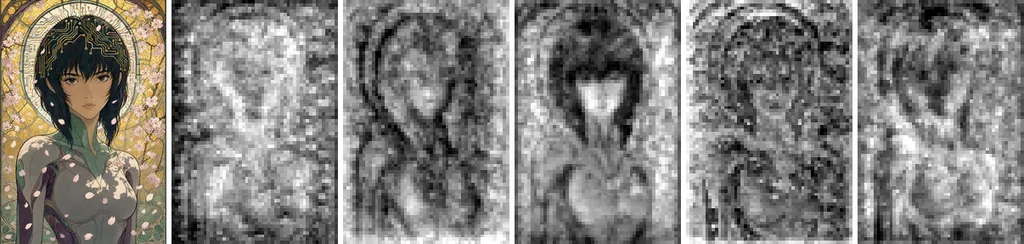
Each latent position is one token for the transformer, so a 1-megapixel image is 3,952 tokens and a 4-megapixel one 15,808. That grid is no coarser than the one of Stable Diffusion 3 or of the first Qwen-Image, which group their 8-fold latent into 2 × 2 patches before the transformer. What 2.1 changes is that the VAE does that grouping itself, in 64 channels. Attention cost grows with the square of the number of tokens, which is why 4 megapixels cost far more than four times 1 megapixel.
Flow matching instead of noise prediction
Stable Diffusion 1.5 and SDXL were trained to predict the noise added to an image. Qwen-Image, like Stable Diffusion 3 and FLUX, is trained with flow matching. The network predicts the direction from the noisy latent towards the clean one, along a straight line. The sampler then follows that direction with Euler steps. The repository names that scheduler, flow matching with Euler discrete steps and a dynamic shift. The first Qwen-Image report describes the objective, a velocity target along straight paths, which the 2.1 scheduler implies is unchanged.
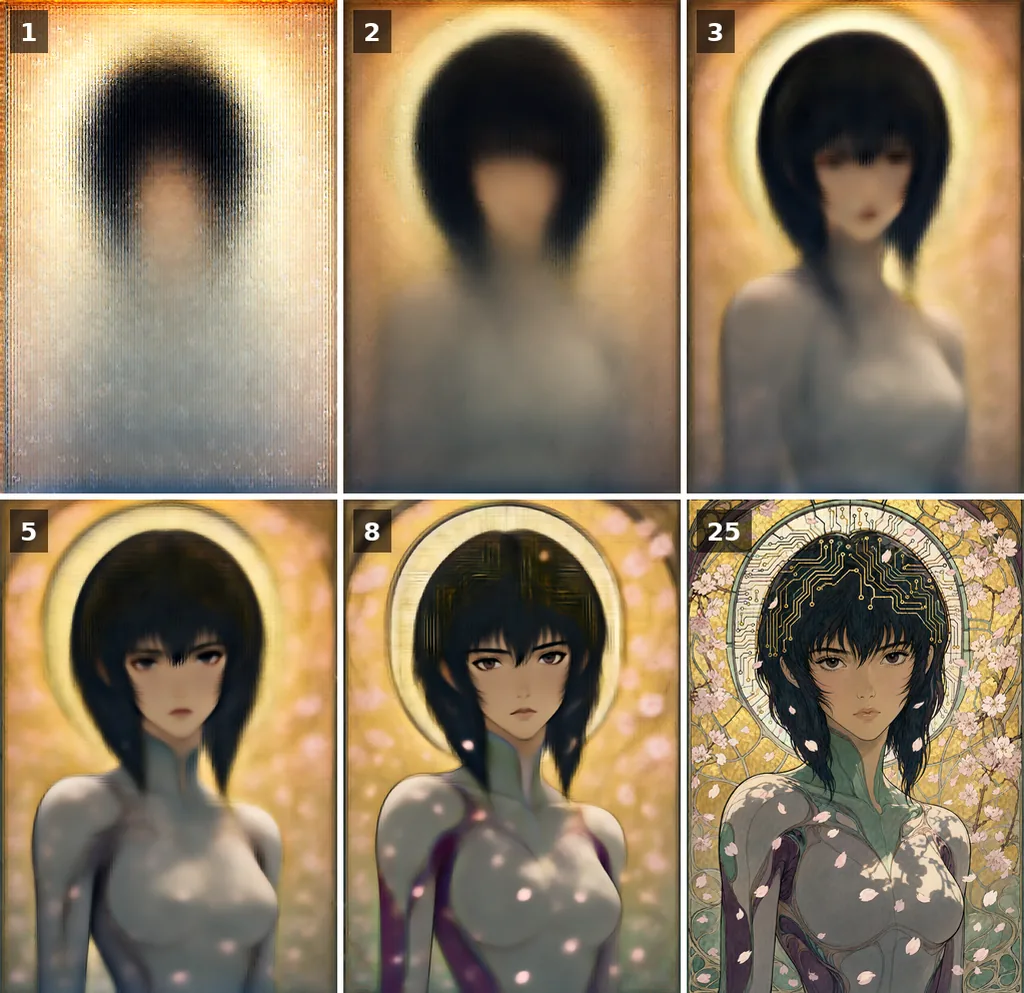
The figure below shows what the model’s estimate of the finished image looks like along the way. The composition is fixed in the first steps and the detail arrives later. This coarse-to-fine order is common to all diffusion models; flow matching mainly changes how the steps are spaced, which is what the dynamic shift tunes.
Side by side
| Stable Diffusion XL | Stable Diffusion 3.5 Large | Qwen-Image 2.1 | |
|---|---|---|---|
| Text encoder | CLIP ViT-L and OpenCLIP bigG | Two CLIP encoders and T5-XXL | Qwen3-VL 8B, a vision-language model |
| Denoiser | U-Net, 2.6 billion parameters | Double-stream MMDiT, 8 billion | Single-stream diffusion transformer, 7 billion, 32 layers |
| Latent | 4 channels, 8× compression | 16 channels, 8× | 64 channels, 16×, with alpha |
| Training objective | Noise prediction | Flow matching (rectified flow) | Flow matching (rectified flow) |
| Native size | 1024 px | 1024 px | 2048 px |
| Editing | Third-party inpainting model | No official editing model, ControlNets only | Same checkpoint, up to 10 reference images |
| Licence | OpenRAIL++-M | Community License | Qwen Research License |
None of this changes how the model is driven. Guidance, steps, seed and size behave as in any diffusion model; only the numbers that work best differ, and the settings guide measures them.
The versions, from Qwen-Image to 2.1
The numbering is confusing because it follows the architecture, not the release channel. Qwen-Image 2.0, announced in February 2026 and never released as weights, introduced the lighter design that 2.1 now ships openly. Qwen-Image 3.0, announced in July 2026, is a bigger flagship served only through Alibaba’s API. Qwen has not explained the scheme; the dates below come from the project repositories and, for 3.0, from Qwen’s announcement.
| Release | Date | What it is | Weights |
|---|---|---|---|
| Qwen-Image | 4 August 2025 | 20-billion-parameter double-stream MMDiT with a Qwen2.5-VL 7B encoder; text-to-image | Open, Apache 2.0 |
| Qwen-Image-Edit, then Edit-2509 and Edit-2511 | August to December 2025 | Editing models on the same base; several reference images from 2509; a layered RGBA model, Qwen-Image-Layered, in December | Open, Apache 2.0 |
| Qwen-Image-2512 | 31 December 2025 | Last text-to-image release of the 20-billion line | Open, Apache 2.0 |
| Qwen-Image 2.0 | 10 February 2026 | The design 2.1 inherits: Qwen3-VL encoder, 64-channel VAE, native 2K, instructions up to 1,000 tokens; technical report in May 2026 | Not published |
| Qwen-Image 3.0 | 21 July 2026 | Flagship behind Alibaba’s API: prompts up to 4,500 tokens, infographics and storyboards rendered in one pass | API only |
| Qwen-Image 2.1 | 20 September 2026 | 7-billion-parameter single-stream transformer with a Qwen3-VL 8B encoder; generation and editing in one checkpoint, RGBA, 2K | Open, Qwen Research License |
| Qwen-Image 2.1 Turbo | 9 October 2026 | Distilled 2.1, 8 steps | Open, Qwen Research License |
So on a download page, “Qwen-Image” without a number is the 20-billion model of 2025, still available with its 2512 and Edit updates. The current open model is 2.1, and 3.0 is the model behind Alibaba’s paid service. 2.1 and 3.0 share a lineage but not their weights.
The Qwen-Image licence: open weights, research only
The first Qwen-Image and its editing models were Apache 2.0: free for anything, commercial use included. Qwen-Image 2.1 and its Turbo are under the Qwen Research License Agreement. The weights can be downloaded, studied, run and fine-tuned, but for research and evaluation only. Any commercial use needs a separate licence from Qwen.
That puts 2.1 in a different place from Stable Diffusion, whose 1.5 and SDXL licences allow commercial use with a list of forbidden uses and whose 3.5 licence allows it below one million dollars of yearly revenue, and from FLUX 3 Klein, free for commercial use below five million. For a student or a lab, nothing changes. For a studio, the paid API or a commercial licence requested from Qwen are the routes that stay open.
Trying Qwen-Image and going further
The quickest way is the free Qwen-Image 2.1 page of this site: no account, generation and editing with reference images, the queue shown live.
To run it at home, ComfyUI supports the model natively. Three files from the Comfy-Org repackaging go in the usual folders: the diffusion model, the Qwen3-VL text encoder and the VAE, int8 versions for a 16 GB card. The guide to the settings covers the graph, the prompt structure, the guidance and the sizes that were measured on exactly that card, plus the Turbo and the guided Turbo.
For the principles shared by all these models, noise, latent space, guidance and seed, read What is Stable Diffusion?; the explanations carry over, only the numbers change.